






No Safe Haven In Gaza
Prepared by Abdullah Bamusi Nankumba
Insight Bulletin – June Edition
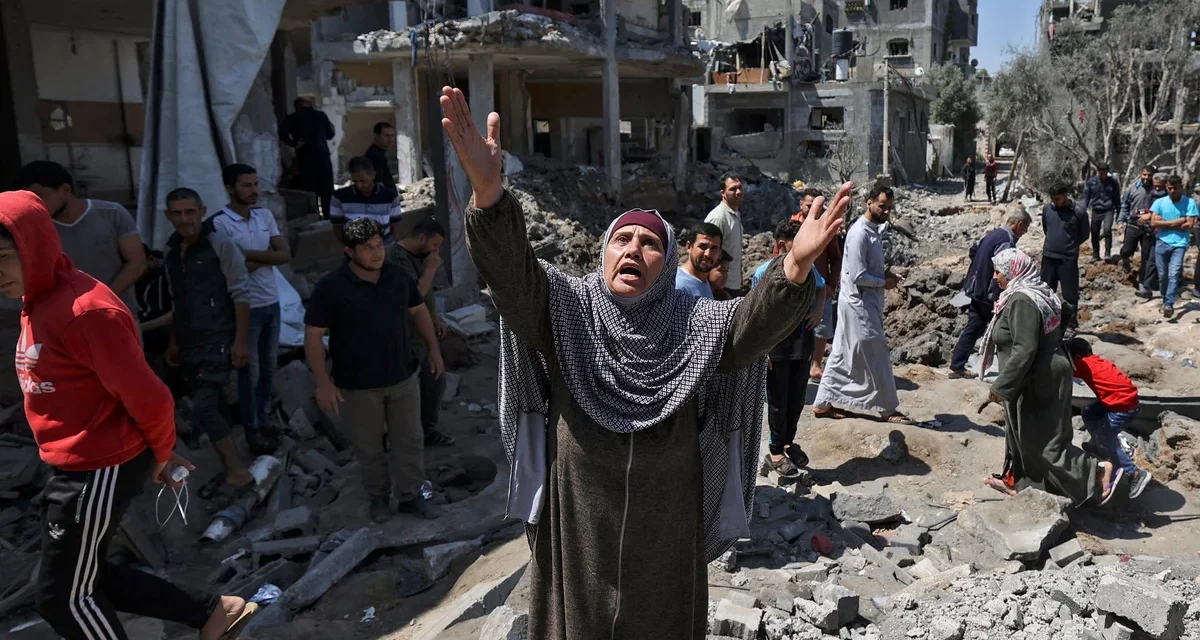
In one of the most devastating attacks in recent weeks, an Israeli airstrike targeted the Fahmi al-Jarjawi School in Gaza City, killing more than 30 people, many of them children. The school, which had been converted into a shelter for displaced families, became the site of what Palestinians are calling a massacre—one that underscores the depth of human suffering in Gaza after months of relentless war.
Once a place of learning and refuge, the school has now joined the growing list of sites destroyed in what has become a war on civilians. Bodies were pulled from the rubble—some small, some unrecognizable. Survivors wept amid the wreckage, asking how much more Gaza must endure.
This attack follows the continued failure of ceasefire negotiations and occurs in the broader context of a war that has killed over 36,000 Palestinians, according to Gaza’s health authorities—most of them women and children. Hospitals are overwhelmed. Basic services have collapsed. There is no safe zone, no reliable shelter, and no end in sight.
A BRUTAL PATTERN OF VIOLENCE
The bombing of the school has drawn condemnation from across the region, yet Israel maintains that its military operations are aimed at Hamas fighters allegedly embedded in civilian areas. However, eyewitnesses and humanitarian groups say the scale and nature of the attack reveal something far more indiscriminate.
Philippe Lazzarini, the Commissioner-General of UNRWA, expressed outrage after the strike, stating, “Gaza has become a graveyard for children.” He called on the international community to act, warning that continued impunity will only deepen the catastrophe.
The Palestinian armed group Hamas issued a statement following the school bombing, describing the attack as “a manifestation of the most heinous crimes against humanity caused by the criminal entity’s impunity for international accountability.”
The statement went on to condemn what it called “international silence and Arab failure to address the ongoing genocidal and ethnic cleansing massacres in the Gaza Strip, the latest of which was the horrific massacre at the Fahmi al-Jarjawi school in Gaza.”
Blame was also cast toward the United States. “We hold the US administration and President Donald Trump fully responsible for this brutal crime and all the crimes committed by Israel against Palestinians,” the group said, “as they continue to be a genuine partner in supporting and providing cover for the entity.”
In a rallying call to action, the statement urged Palestinians “to shake off the dust of inaction and impotence and stand up for the bloodshed in Palestine.”
DESPERATION AND DISPLACEMENT
Gaza’s humanitarian crisis has reached unbearable levels. Over 80% of the population has been displaced, many multiple times. They live in overcrowded shelters, temporary camps, or under tarps in bombed-out ruins. Clean water is nearly nonexistent, food is critically short, and diseases are spreading in areas lacking even basic medical supplies.
The Fahmi al-Jarjawi school was just one of many public buildings—mosques, hospitals, universities, and UN facilities—repurposed as shelters in the absence of safety. But as this strike demonstrates, even designated humanitarian zones have not been spared.
A local teacher who survived the attack said, “We had nowhere else to go. The school was our only shelter. Now it’s a cemetery. Our children were studying here. Now we are burying them here.”
A CRISIS BEYOND STATISTICS
Each death in Gaza represents a human life cut short, a family shattered, a future erased. For every body pulled from the rubble, there are parents without children, siblings without brothers or sisters, and communities forever altered.
The continuous bombardments are taking a psychological toll as well. Children no longer speak freely—they flinch at loud sounds, wet their beds, and cry through the night. Aid workers report widespread trauma among survivors, especially the young, who are now referred to by doctors as the “lost generation.”
Despite widespread condemnation from global humanitarian agencies and protest movements around the world, efforts to impose a meaningful ceasefire or hold Israeli forces accountable have faltered repeatedly at the UN Security Council, largely due to vetoes by powerful allies of Israel.
THE WORLD CANNOT LOOK AWAY
As the death toll rises, so too does the moral urgency. The world cannot continue to offer statements of concern while standing by as civilians are slaughtered. Every delay in action is measured in lives lost—many of them children.
The bombing of the Fahmi al-Jarjawi school is not just another event in a long list of war crimes. It is a symbol of how far Gaza has fallen into a state of total despair and how little the world’s political will has achieved in ending this carnage.
Until accountability is pursued and real pressure is applied on all parties to end the bloodshed, more classrooms will become graves. More children will be erased from family photographs. And more Palestinians will be left to wonder whether anyone in the world truly sees them.