









GAZA IS BLEEDING IN BROAD DAYLIGHT: How Many Cries Must the World Ignore?

Prepared by Abdullah Bamusi Nankumba
A Crisis the World Has Normalised
Across international newsrooms, political platforms, and diplomatic corridors, the crisis in Gaza has taken on a disturbing familiarity. What should shock humanity has instead become a recurring bulletin—another bombardment, another neighbourhood flattened, another child wrapped in white cloth. The world has learned to scroll past suffering.
Yet for Palestinians, this is not another episode in a long news cycle. It is daily life. It is the sound of drones replacing the sound of birds. It is the fear of sleeping because nightfall often invites the deadliest strikes. And when bombs fall silent for a moment, calamity still finds them in other forms—storms, disease, hunger, untreated wounds, and the exhaustion of surviving each day with nothing but resilience.
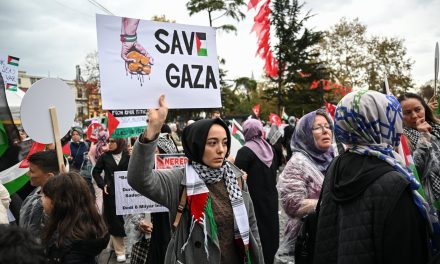
Gaza is bleeding in broad daylight, and the world is watching.
When War Is Not the Only Enemy
While Israeli bombardments remain the most visible agent of destruction, they are not the only threat. Gaza’s population now confronts multiple calamities at once, each one compounding the next. Storm Brydon, which recently tore through the Strip, was a natural disaster—yet in Gaza, even nature becomes political.
Makeshift shelters built from tarpaulins and metal sheets stood no chance against the storm. Families displaced by airstrikes found themselves exposed to harsh winds and rain, with children shivering in cold corners because winter clothing and blankets are scarce luxuries. Flooded tents, soaked mattresses, and contaminated water sources created yet another layer of vulnerability.
A local aid worker summed up this grim reality:
“When the storm came, it did not destroy houses—because the bombs had already done that.”
Hunger as a Weapon of Circumstance
In Gaza, hunger is not an abstract statistic. It is a child crying until their voice weakens. It is a mother mixing flour with water to create something that resembles food. It is families boiling leaves because there is nothing else to eat.
With aid convoys frequently blocked, delayed, or restricted, the Strip’s food supply has become dangerously inconsistent. Relief organisations repeatedly warn of acute malnutrition among infants and toddlers—warnings that materialise in heartbreaking reports of children dying not from bullets or blasts, but from starvation.
A doctor working with minimal resources inside Gaza remarked,
“We no longer lose children because we couldn’t treat them. We lose them because there is nothing left to treat them with.”
The crisis is not simply humanitarian—it is moral.
Life Under Blockade: A Ground-Level Perspective
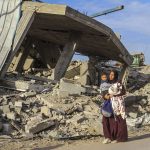
Behind the headlines lies a deeper humanitarian collapse. Hospitals—what remains of them—struggle to power incubators, perform surgeries, or even clean wounds. Fuel shortages have crippled water treatment plants, leaving thousands without access to clean drinking water. Schools have turned into shelters, and shelters have turned into mass graveyards when targeted.
Families displaced multiple times describe living in constant fear. Many carry bags packed with essentials—documents, a few clothes, and a small piece of home—in case they must flee again at a moment’s notice. Others have no home left to return to and nowhere else to run.
For them, survival is not hope. It is habit.
Storm Brydon: A Reminder of Vulnerability
When Storm Brydon descended on Gaza, it exposed how vulnerable the Strip has become after years of political blockade and destruction. The storm uprooted tents, swept away makeshift possessions, and worsened already fragile sanitation conditions. For the displaced, the storm was a second disaster layered on top of the first.
Children who survived airstrikes found themselves braving harsh weather without proper shelter. Pregnant women slept in cold flood-soaked tents. The elderly struggled with respiratory infections because basic medicine is unavailable.
Storm Brydon did not cause the crisis—it magnified it.
A Call to Conscience
The suffering in Gaza is not inevitable. It is not a natural phenomenon. It is not an unfortunate coincidence of events. It is the direct result of prolonged conflict, political paralysis, and global hesitation.
This December, as the world reflects on another year ending, Insight Bulletin calls upon its readers to look beyond passive consumption of tragedy. Advocacy must translate into support. Condemnation must translate into real pressure on global leaders. Humanity must move beyond silence.
Because Gaza is not asking the world for miracles—only for justice, dignity, and the right to live.
And this time, the question is not whether Palestinians will survive another storm, another conflict, or another shortage.
The real question is whether the world will finally act before Gaza’s last cry fades into a silence we will one day regret.