

















Inside Mutharika’s Partial Cabinet: Political Balance or Strategic Appeasement?
By Tagamchira Meeklem Chiperesa
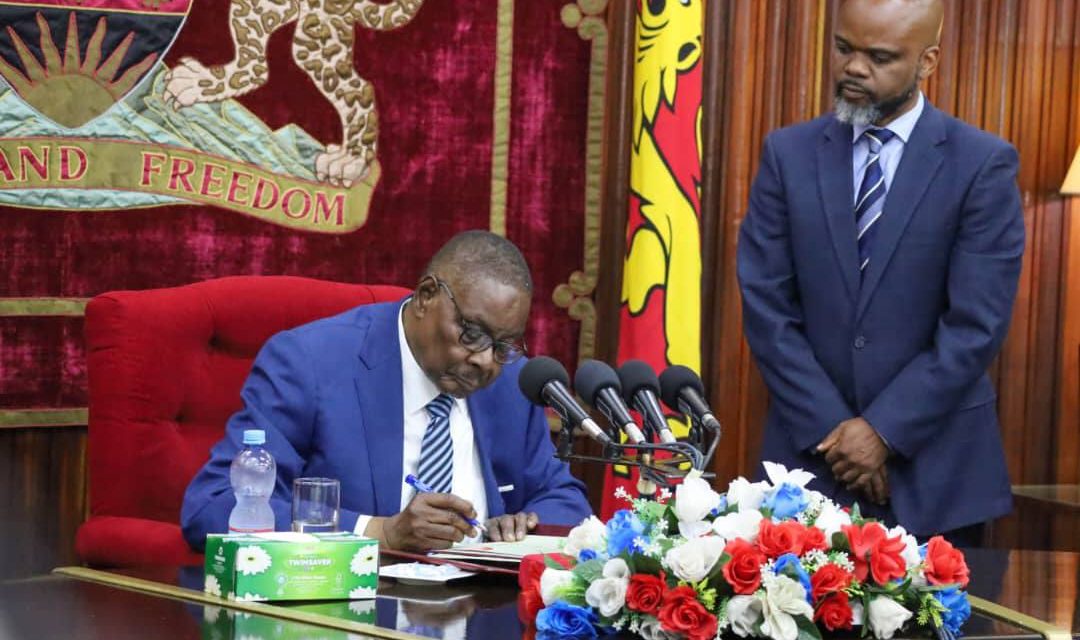
President Peter Mutharika’s recent unveiling of a partial cabinet has reignited debates over Malawi’s governance structure and the constitutional relevance of certain executive offices.
Among the key appointments are Jane Ansah as First Vice President, Enock Chihana as Second Vice President, George Chaponda as Minister of Foreign Affairs, Joseph Mwanamvekha as Minister of Finance, Economic Planning and Development, and Alfred Gangata as Minister of State. Notably, major portfolios such as Education, Health, Agriculture, and Homeland Security remain vacant, with the President expected to complete his cabinet in the coming days.
The appointment of Enock Chihana, leader of the Alliance for Democracy (AFORD), as Second Vice President has drawn significant attention. Legal expert Kennedy Osman has described the move as “political appeasement that offers little value to the country’s governance.” He pointed out that while the Constitution of Malawi empowers the President to appoint a Second Vice President, the provision is not mandatory, and the position holds limited practical influence unless the President assigns it specific responsibilities.
The appointment of a Second Vice President is guided by Section 80(5) of the Constitution of Malawi, which states:
“The President may appoint a person who is not from the political party that sponsored him or her into office to serve as Second Vice President.”
Additionally, Section 80(7)(e) stipulates that:
“The office of the Second Vice President shall not be occupied by a Member of Parliament unless that person resigns from the National Assembly.”
The intent behind these provisions, introduced through the Constitution (Amendment) Act No. 38 of 1998, was to promote inclusivity and coalition-building by allowing the President to bring in leaders from other political parties.
The Second Vice Presidency is not new in Malawi’s political landscape. The position was first used by Dr. Bakili Muluzi in the mid-1990s when he appointed the late Chakufwa Chihana, founder of AFORD and father to Enock Chihana, as Second Vice President. That move followed a political alliance between Muluzi’s United Democratic Front (UDF) and AFORD, aimed at stabilizing his government and ensuring regional representation. Like today, it was seen as a gesture of political compromise rather than a structural necessity for governance.
Osman also drew comparisons between the Second Vice Presidency and the newly reintroduced Ministry of State, now headed by Alfred Gangata, arguing that both roles exist more for political accommodation than functionality. He explained that the Minister of State would work closely with the President, “running errands and interconnecting ministries,” but questioned whether such a position is necessary.
Despite his criticism, Osman urged Malawians to remain patient and observe whether President Mutharika will assign tangible responsibilities to the newly appointed officials. The revival of the Second Vice Presidency—once a symbol of unity under Muluzi’s government—now places Mutharika in familiar territory: balancing political loyalty, constitutional flexibility, and public expectations. Whether the move strengthens inclusivity or simply revives old patterns of political appeasement remains to be seen.